
We Must Renew our Commitment to the World that Supports Us
Earth Day represents more than just a reminder of decades old environmental activism.
Today is April 22, 2026, the 56th anniversary of Earth Day.
The emergence of fossil fuels as a low cost and abundant energy resource over the past two centuries has unmistakably led to a remarkable growth in the material well-being and economic condition of the world’s citizenry. But as economies and populations grew, the adverse consequences of burning these fossil fuels to drive the industrial revolution became more and more apparent, and, in many cases, even dire. By 1970 environmental conditions in many parts of the world had degraded to such an alarming level that a special day was designated to raise awareness and seek solutions before matters became even much worse. That day is called Earth Day.
Earth Day was first proposed by a peace activist named John McConnell at a UNESCO Conference in San Francisco in 1969. The intention was for the first earth day to occur on the vernal equinox of March 21, 1970. Mr. McConnell wrote this proposal into a proclamation that was signed by United Nations Secretary General U Thant.
A month after his proposal Senator Gaylord Nelson from the state of Wisconsin proposed to hold a national environmental teach-in on April 22, 1970. The Senator hired Denis Hayes, a young activist, to convert Senator Gaylord’s vision into a national event.
However, the term “teach-in” was not garnering much public support. So, Mr. Hayes met with a copywriter named Julian Koenig, well known for his work on numerous advertising campaigns, who came up with the idea for calling the event Earth Day.
The first Earth Day was an immediate success, with 20 million people, or about 10% of the population, participating in events around the U.S. The event triggered a national awareness that helped inspire some of the most important environmental legislation ever passed in the U.S. Three months after this first Earth Day the U.S. Environmental Protection Agency was formed. The Clean Air Act of 1963 was amended and strengthened in 1970 to require all states to develop approved air quality control implementation plans. A sweeping Clean Water Act followed in 1972, and the Endangered Species Act in 1973. Concurrently, many private and non-profit groups sprung up, creating robust opportunities for civil engagement.
Mr. Hayes went on to serve as the first Director of the Solar Energy Research Institute (later known as National Renewable Energy Laboratory; and now the National Laboratory of the Rockies). He became president of the Bullitt Foundation in Washinton State in 1992. In 2009 the Foundation began developing the Bullitt Center, tagged as “the greenest office building in the world”. To this day Mr. Hayes continues as an environmental advocate.
For many years Denis Hayes was associated with the American Solar Energy Society (ASES), the oldest, continuously operating pro-solar energy organization in the world. ASES had its start in 1954, when it was first known as the Association for Applied Solar Energy, or AFASE. In the 1960s AFASE changed to the Solar Energy Society (SES). Then, in 1970, following a successful international solar conference in Melbourne, Australia, the Board of SES agreed to form the International Solar Energy Society, or ISES, to be headquartered in Australia. ASES and its counterpart in Melbourne, the Australia/New Zealand Solar Energy Society, or ANZSES, subsequently became the first “Sections” of ISES. ANZSES is now the Australian Smart Energy Council. All of these organizations remain very active to this day.
In 1993 Mr. Hayes received the prestigious Abbott Award from ASES, and in the early 2000s chaired the ASES Board of Trustees.
Thanks to Mr. Hayes’ activism, Earth Day became an international phenomenon by the 1990s and remains so to this day. Events are now organized in over 140 countries.
Early Earth Day events tended to focus on raising awareness of local and regional environmental problems: air quality degradation, river pollution, losses in biodiversity, harmful land use practices, and protection of natural resources. This remains the case to this day, but another environmental issue has clearly taken hold.
In 1970 the notion of climate change was hardly being discussed, other than within the scientific community. But over the years climate change has now become a major focus of local and regional Earth Day events.
As shown in a plot of annual temperature anomalies provided by Berkeley Earth, global warming had barely reached 0.3 0C above preindustrial levels (generally accepted as the measurement period from 1850 – 1900) by 1970. In fact, from the end of World War II to the early 1960s global temperatures remained relatively constant, despite large year-to-year variations.
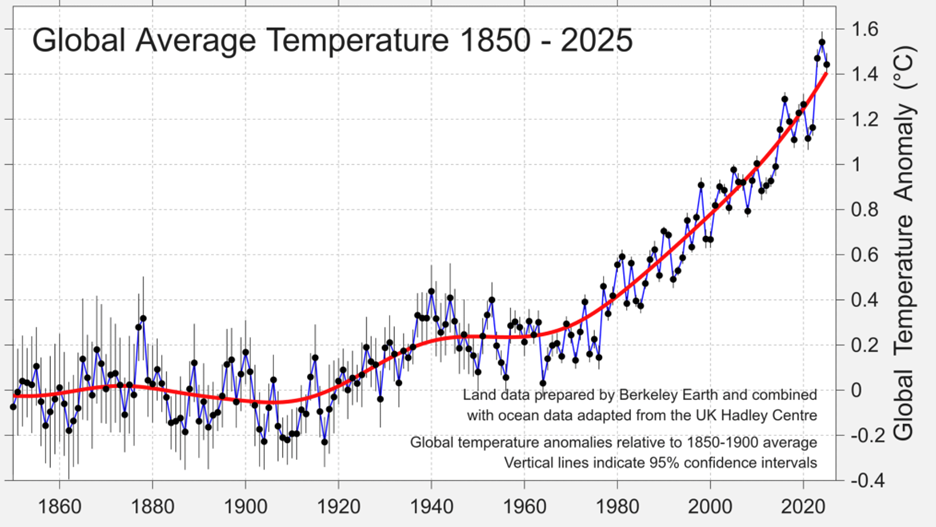
Figure 1. Annual global temperature anomalies relative to 1850-1900 average. (Source: Berkeley Earth)
Some of this global warming slow-down has been attributed to a rising concentration of particulate matter in the atmosphere resulting from the intense industrialization that occurred post-World War II. The cessation in global warming during this period can be explained, in part, by the lack of meaningful air pollution controls prior to the 1960s, resulting in increasing concentrations of atmospheric particulate matter. Although atmospheric CO2 concentrations increased steadily during this period, as shown in the chart below, atmospheric particulates reflected some of the incoming sunlight back to outer space and therefore created a cooling effect that potentially offset the warming that resulted from the increasing CO2 concentrations. Global efforts to reduce particulate air pollutants grew in earnest in the late 1960s, and significant air quality controls have been implemented since the early 1970s. With less particulate matter, warming began to accelerate in the early 1970s. Since the first Earth Day, CO2 concentrations have increased from about 325 ppm to around 430 ppm today.
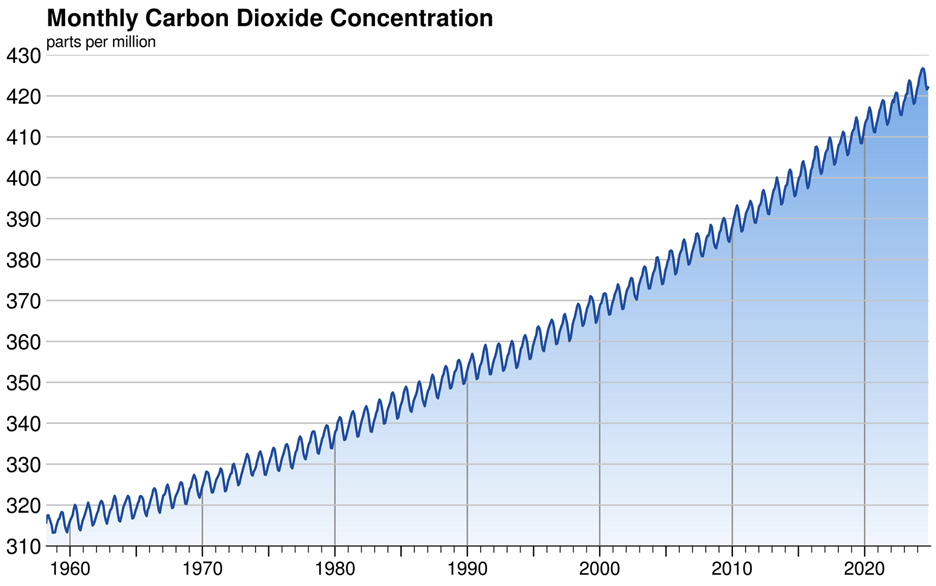
Figure 2. Mauna Loa Observatory, Hawaii, CO2 Record. (Source: Scripps)
In 1970 renewable technologies, especially solar and wind energy technologies for producing electricity, were largely in the experimental phase with a limited commercial presence. The only widely used renewable power technology at the time was hydropower.
But since 1970 other renewables, specifically wind and solar, or Variable Renewable Energy (VRE) technologies, have experienced great commercial success. The world now has 5.15 TW of installed renewable capacity. Although much of that capacity is hydropower, about 35% can be categorized as VRE, as recently reported by IRENA. Nearly half of the world’s total power capacity now comes from renewables (there are strong movements worldwide to see total renewable energy capacity be 100%). In recent years 90% or more of newly installed electricity capacity is categorized as renewable.
But the headwinds pushing against a renewable energy transformation have become stronger. The fossil industry, seeing threats to its profits and expansion opportunities, and even to its very existence, is lobbying hard with many governments, especially in the U.S., to protect their interests, with varying degrees of success. Although these efforts are to the detriment of clean energy programs, in reality the transformation to a renewable energy system is not stoppable.
There is good reason as to why the majority of all new electricity capacity being installed around the world is based on renewable technologies. Costs have dropped dramatically, deployment times are much shorter than what is possible with fossil technologies, and, when combined with battery storage, offer substantial grid flexibility.
Although the International Energy Agency calls the current war in Iran “the mother of all energy crises”, it is in reality a fossil energy crisis, and not a renewable energy crisis. As pointed out by David Wallace-Wells in today’s New York Times, the war has, in many ways, boosted green energy programs; a “green lining” in an otherwise very “dark cloud”.
The fossil industry has reason to feel threatened by the energy transformation, and given the benefits society has obtained through the fossil-driven industrial revolution, it would be unfair, and obviously unwise, just to kick this industry aside, applying a stick without offering a carrot. Much of our economy is built around the existing fossil infrastructure. Millions of people have thrived with the industry, and billions have benefited in quality of life improvements. Talk of a true “fossil fuel phase-out” has been raised at the annual climate negotiations that take place at the Conferences of the Parties (COPs), but the challenges of a just phaseout that offers proper remuneration to affected communities and workforce re-training to all the effected workers has prevented national governments from signing off on this language in the negotiated COP agreements.
A step in that direction may be taking place this coming week at the First Conference on Transitioning Away from Fossil Fuels, being held in Santa Marta, Colombia on April 24-29.
Earth Day has long been about accountability. Who pays the costs of environmental impacts? Is it governments, or the polluting industries, or the citizens whose lives are being impacted? Besides the efforts of global climate negotiations, Earth Days of the future must continue to strive to highlight and debate these issues.
We need Earth Day more than ever now. And in a sense, every day needs to be an Earth Day. Even my 14-year-old grandson, Max, told me this recently. So I urge all of the readers of the SunBurst Almanac to take actions and make personal commitments towards achieving a fossil-free future every day.
This article was originally published in Dave's Substack, the SunBurst Almanac.