RTC 2025 Winner is Agrisol from Indonesia enabling rural agriculture powered by solar energy
Elsevier and the International Solar Energy Society ISES are pleased to announce the Indonesian project Agrisol as the winners of the 2025 Renewable Transformation Challenge!
In many parts of Indonesia, agriculture remains vulnerable to the whims of the weather – this is especially true for smallholder farmers who rely solely on unpredictable rainfall. Affordable irrigation is vital to sustain successful planting seasons – without it, entire seasons can be lost during the dry months. Farmers are often forced to wait for rain or use expensive petrol-powered irrigation pumps that are also noisy and harmful to the environment, and most significantly, often push farmers into debt. In some seasons, the cost of petrol is so high that letting crops fail is the only option.
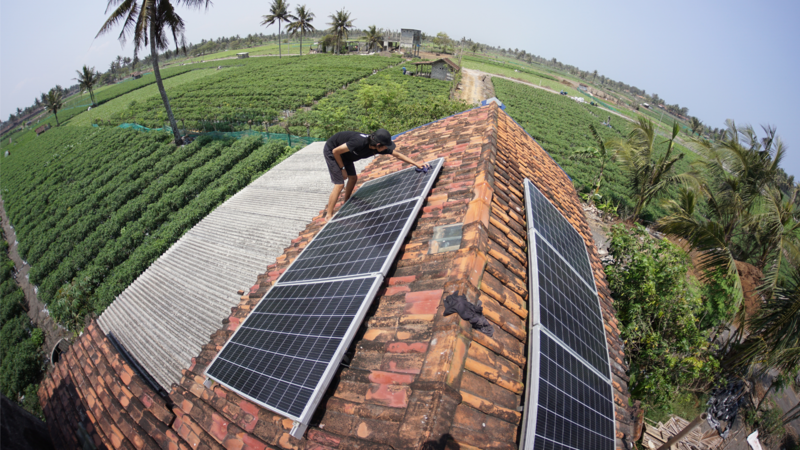
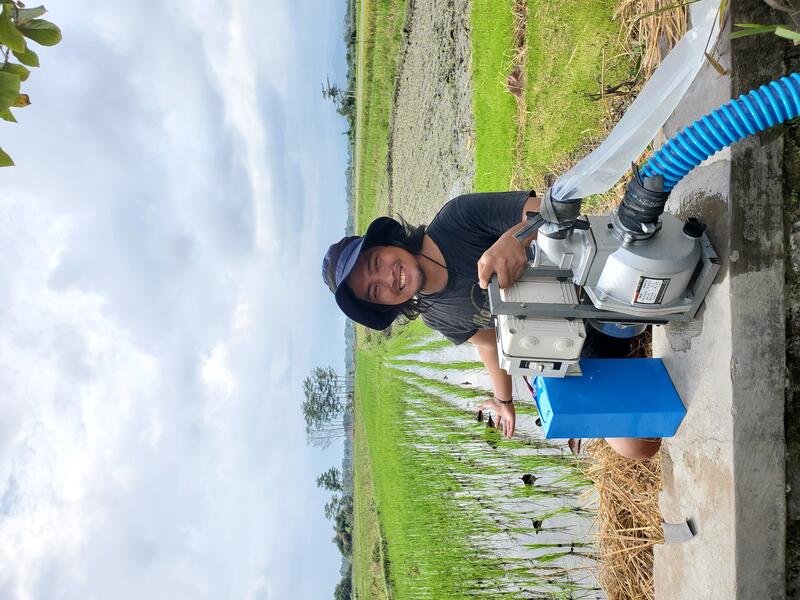
Solar-powered irrigation systems are a sustainable and affordable alternative to traditional fossil-fuel-powered pumps, providing reliable access to clean water at a fraction of the cost. Agrisol, built by Mobah Teknologi, is an irrigation system built on social and technological innovation. A portable water pump, the Agrisol-pump, is powered by solar-charged batteries and designed specifically for use on small farms. Batteries are housed in a “battery swap station” and charged through rooftop solar panels that are shared between communities.
Farmers using Agrisol’s system get fuel-free irrigation up to 500 liters per minute, saving as much as IDR 2.1 million (approx. US$125) every month on potential fuel costs. Alongside the financial savings to each farmer, every unit benefits the environment by eliminating about 210 liters of gasoline used monthly, reducing carbon emissions by over 480 kg of CO2 per year.
Benefits go beyond cost savings. For traditionally rain-fed agriculture, the new system enables farmers to plant more frequently, even during the dry seasons. With one or two additional harvest cycles every year, farmers produce more food and more income. For families who have long faced the uncertainties of weather and fuel prices, this brings greater stability and security.
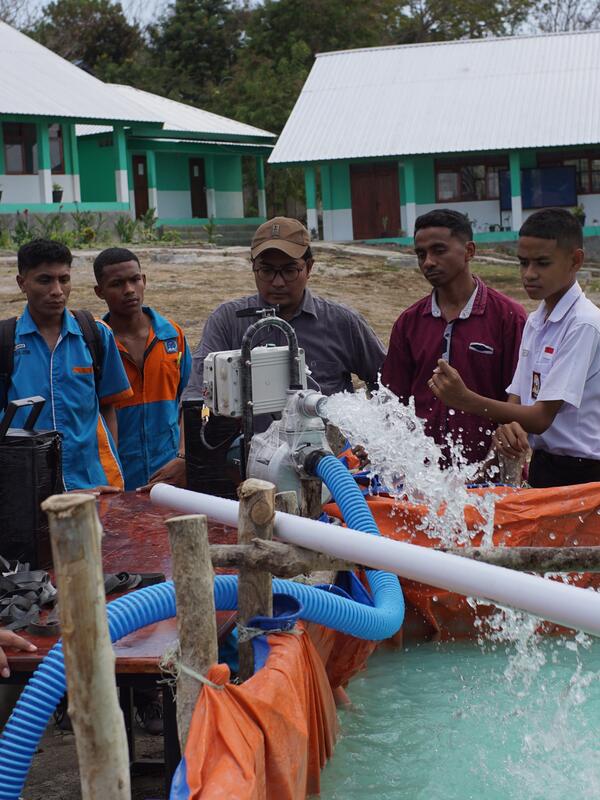
It’s not only individual farmers and their families that reap the rewards from the Agrisol irrigation system – scaling the program can meet a community’s current and future needs. By partnering with local vocational schools for the construction and maintenance of pumps, the program creates job opportunities, builds technical capacity and establishes long-term support networks within the community.
By including ever more farmers, the needs of communities are monitored in real-time. Farmers participate in field trials and help adapt the system design in response to changing conditions. Through this consultative approach, Agrisol by Mobah Teknologi embodies its mission: to empower farmers with energy independence, increase their harvests, and reduce poverty—while fighting climate change from the ground up.
To date, Mobah Teknologi has set up 10 irrigation systems, enabling 10 selected farmers to use Agrisol-pumps across six harvest cycles. Early pilots are running in Yogyakarta and Tasikmalaya on Java and in East Nusa Tenggara and providing promising results for scaling up the program.
Using the €20,000 prize from the Renewable Transformation Challenge, Agrisol intends to implement its five-year roadmap and scale up across Indonesia by:
- Deploying over 3,000 Agrisol-pump units
- Supporting over 1,000 farmers
- Enable the reduction of over more than 2,000 tons of CO2 per year
“Winning the Renewable Transformation Challenge is more than just recognition—it’s a powerful validation of our belief that farmers deserve clean, accessible technology that helps them build sustainable and prosperous livelihoods. This award fuels our mission to empower rural communities with renewable solutions that don’t just reduce emissions, but increase harvests, income and self-reliance.” – Roshady Said, Founder of Agrisol by Mobah Teknologi
The Renewable Transformation Challenge, launched in 2017, aims to honor and showcase outstanding work that actively supports the transformation to a world powered by renewable energy and has potential to widen access to energy, particularly in developing countries. The challenge was open to individuals and organizations in both not-for-profit and commercial sectors worldwide. Over 152 entries were received which were scored in terms of applicability, impact, sustainability and scalability in two stages: first by the Juror Panel, and then by the Elsevier-ISES Awards Committee who selected the final winner from the ten shortlisted candidates.
Prof. Klaus Vajen, head of the joint awards committee comments: “It was a very difficult decision this year, as we received many excellent submissions. Agrisol has impressively demonstrated how solar technology stands out in terms of cost-effectiveness, environmental friendliness and social compatibility, also for applications that have received only little attention to date.“
A representative from Agrisol has been invited to present on their project at the Solar World Congress 2025, held 04-07 November in Fortaleza, Brazil.
Photo 1: Solar-charged and community-shared battery swap station placed near farmlands in Kulon Progo, Indonesia. Photo by Mobah Teknologi, SolarGenerationID and EnterNusantara Team.
Photo 2: Agrisol pump serving rice field farmers in Sleman Prambanan, Indonesia. Photo by Mobah Teknologi Indonesia.
Photo 3: Preparing local vocational schools for pump production and maintenance services in Atambua, Indonesia. Photo by Mobah Teknologi Indonesia.
All photos by Agrisol
About the Renewable Transformation Challenge
The Renewable Transformation Challenge, launched in 2017, aims to honor and showcase outstanding work that actively supports the transformation to a world powered by renewable energy and has potential to widen access to energy, particularly in developing countries. The challenge was open to individuals and organizations in both not-for-profit and commercial sectors worldwide.
Over 150 entries were received which were scored in terms of applicability, impact, sustainability and scalability in two stages: first by the Juror Panel, and then by the Elsevier-ISES Awards Committee who selected the final winner from the ten shortlisted candidates.
A representative from the Agrisol team has been invited to present on their project at the Solar World Congress 2025, held 04-07 November 2025 in Fortaleza, Brazil.