
A Heartfelt Thank You to an Enduring Institution
I bid a fond farewell to the International Solar Energy Society’s Board of Directors. But I will always remain dedicated to the Society and its legacy.
Today is July 8, 2026. Two hundred and fifty years ago today the newly signed Declaration of Independence had its first public reading in Philadelphia.
When a relationship comes to an end, either through design or from sudden, unexpected circumstances, one must contemplate what value that such a relationship had brought to their life, and what that value means for the rest of their life.
This is true whether we are talking about relationships among humans, or relationships between humans and the institutions for which they have chosen to align their lives.
On July 1, after twenty two and one half years, I completed my twelfth and final term as a member of the Board of Directors of the International Solar Energy Society (ISES). This was by design; it was time for me to step aside, and make room for a younger, more energetic individual with absolute passion for the idea of a world powered by solar energy and with the skills and motivation to actively advocate for its use around the world.
I previously wrote about ISES, and its U.S. Section, the American Solar Energy Society (ASES) in my Earth Day posting on April 22. When I first joined the ISES Board, in 2004, Board Directors were selected by the ISES Sections. I was already on the Board of ASES at that time and was appointed by ASES to serve on the ISES Board. A few years later the ISES Board elected me to be the Vice President for Science and Technology. Then in 2010 the ISES Board elected me as President, a position I held for 10 years.
ISES has a rich tradition of promoting research in all renewable technologies, although its main focus has always been on solar technologies. The history of ISES[1] begins in 1954 when, at the urging of Prof. Farrington Daniels, the Association for Applied Solar Energy (AFASE) was incorporated in Arizona. At that time the solar technologies being studied were often technologies designed for space and water heating, or process heating. That same year Bell Telephone Laboratories patented the modern photovoltaic (PV) solar cell. But still, at that time solar energy was primarily a topic for the research community, with virtually no commercial offerings available.
The first conferences of the AFASE were held in Tucson and Phoenix, Arizona in late 1955. These conference attracted international participation, which continued to grow within AFASE. In 1964 the name of AFASE was changed to the Solar Energy Society (SES), and Farrington Daniels became its first President. Following a joint conference in Melbourne, Australia with its Australia-New Zealand branch in 1970, SES changed its name to ISES to be recognized as an international society. ASES was then formed to become a Section of ISES. Since the Melbourne Conference ISES has held Solar World Congresses every two years.
The journal Solar Energy was started by the AFASE in 1957, along with a more popular publication called “Sun at Work” (in 1976 the name changed to SunWorld). SunWorld continued until 2000, when it was replaced by Elsevier’s publication Renewable Energy Focus (ReFocus). By 2010 ReFocus became an independent publication of Elsevier, no longer connected to ISES. Recently ISES began publishing a second journal, “Solar Energy Applications”. These two journals and the Congresses are among the most visible activities of ISES. For many years ISES also published “ISES News”, and continues to produce a periodic newsletter.
When ISES was formed in Australia in 1970 the headquarters also moved to Australia, although the laws of the Society remain incorporated in Arizona to this day. In the 1970s ISES thrived in part due to a key geopolitical event, the OPEC oil embargo. ISES membership grew more than tenfold by the end of the decade, and had 10 active Sections by 1977, with more to follow. But by the mid-1980s membership numbers fell significantly, due in part to R&D cutbacks in the U.S. and elsewhere. Maintaining the HQ in Melbourne soon became impractical since the majority of ISES members were in North and South America and Europe. In 1993, during a period of serious financial decline, ISES moved from Australia and established its legal entity in Germany. ISES HQ moved into Villa Tanheim in Freiburg.
A few key factors helped the Society turn around its financial misfortunes in the 1990s. One was its participation in the Rio Conference in 1992 and its ability to eventually become a United Nations (UN)-accredited organization, allowing ISES to have a seat at the table at UN meetings addressing sustainability and climate change. Another was the recognition that renewables, and especially wind technologies, were rapidly becoming commercially viable enterprises. The Society began adjusting its publications and Congresses to reflect this. Although it was still viewed as a primarily academic organization, it modified its membership structure to allow for non-academics to join the Society. Many of the Board discussions during that time focused on how ISES should be positioning itself in the rapidly changing renewable energy landscape. These discussions continue to this day.
Ever since my engagement with the Society, which started in the early 1990s, I experienced the constant debate over how to preserve ISES’ academic identity, for which it was highly respected throughout the world, and still appeal to broader audiences such as decision makers, industry, and end users. These were, in fact, the primary issues I took on during my Presidency, which began in 2010.
For sure I saw our UN accreditation as a unique asset and worked to build on it through our participation in the United Nations Framework Convention on Climate Change (UNFCCC) annual Conferences of the Parties (COPs). Working with a unique partnership called the REN Alliance, representing not only ISES but also the World Wind Energy Association, the International Hydropower Association, the International Bioenergy Association, and the International Geothermal Association we organized side events and press conferences at the COPs. Especially in the earlier years of the climate negotiations, renewables did not seem to play a significant role as a pathway to climate change mitigation, but the side events were often well attended and demonstrated the idea of how “renewables working together” can lead to a 100% renewable energy world.
During that same decade of my Presidency the Society also formed new or built on existing partnerships with other key organization dedicated to promoting a renewable energy world, such as the Renewable Energy Network for the 21st Century (known more commonly as REN21) and their International Renewable Energy Conferences, the International Energy Agency’s Solar Heating and Cooling Technology Collaboration Programme, the International Renewable Energy Agency (IRENA) and its Coalition for Action, Intersolar GmbH (especially Intersolar Europe), the International Solar Alliance, the Global Solar Council (in which ISES was a founding member in 2015), and others. These partners all place high value on the science and technology expertise ISES brings to their programs.
For any organization, or organism for that matter, to thrive, it must remain flexible to diversify when the time is appropriate. ISES is no exception. ISES at its core is an academic organization, and it has performed its mission in this regard exceedingly well throughout its history. And for sure many R&D successes reported by ISES in its publications and Congresses have led to commercial successes. ISES should be proud of its legacy. Going forward, ISES has the opportunity to expand this legacy by continuously connecting the innovative outcomes of the research community it supports with the business community that marshals these innovations into successful enterprises. It is also more critical than ever for ISES to get the vast wealth of information garnered within the ISES community out into the mainstream to offset misinformation generated by politicians and companies who oppose the clean energy revolution.
I have full confidence in the new President of ISES, Dr. Francisco Beltran, to provide the necessary leadership for building on ISES’ value and its legacy. I am very impressed with his energy, his enthusiasm, and his intellect. The new Board of Directors, many serving on the Board for the first time, is also impressive. Working with Francisco they are fully capable of implementing programs that further advance this legacy.
I am also deeply grateful to ISES HQ for their unwavering dedication to the ISES mission they have shown for all the years I have known them. They provide the critical support and direction of ISES’ ongoing activities that make ISES the unique organization it is today, an organization with over 70 years of continuous service to the renewable energy community.
ISES, and ASES, represent communities of individuals and institutions passionate about advancing renewable energy technologies. Many of the ideas and motivations for building our off-grid solar home in Colorado come from the many friends and acquaintances I have made in my 35 years of involvement with these two organizations. Check them out...and consider becoming a member, if you are not already!
[1] The Fifty-Year History of the International Solar Energy Society and its National Sections, Vol 1 and 2. edited by Karl W. Boer, U of Delaware, 2005. Published by the American Solar Energy Society, Boulder, CO.
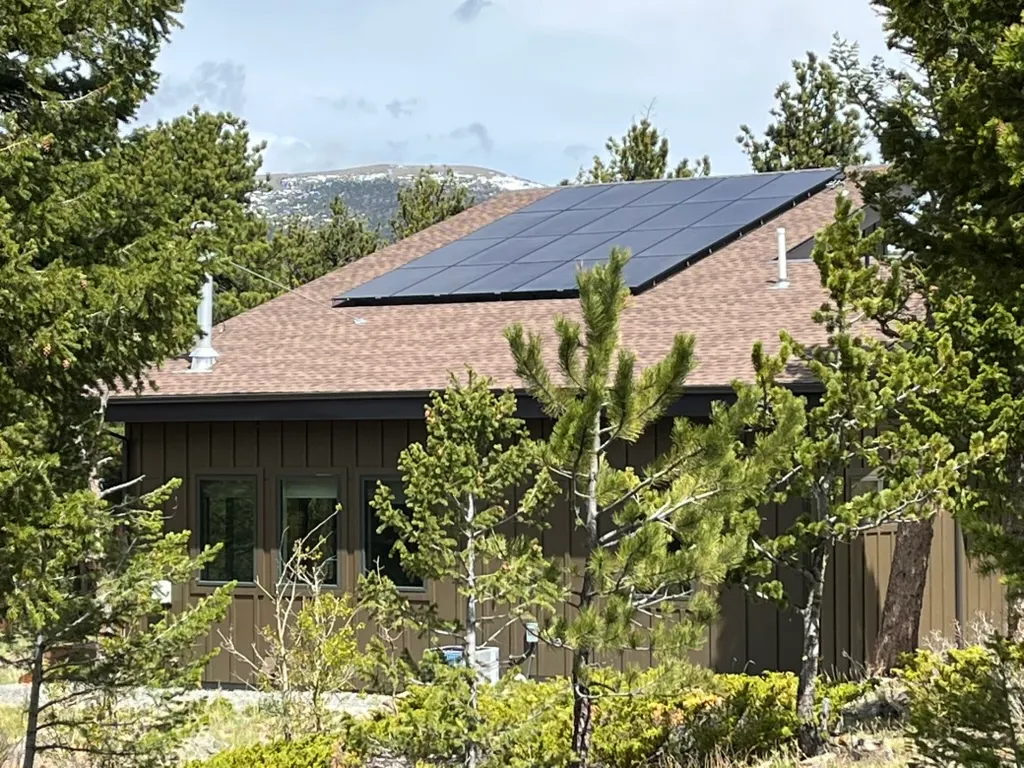
Our 100% electric off-grid mountain home is powered by a 7.3 kWp REC™ 365 N-Peak 2 monocrystalline n-type solar PV system. A wood stove supplies supplemental heat. Photo taken on May 17, 2026.
This article was originally published in Dave's Substack, the SunBurst Almanac.